
What are the benefits of chasteberry?
Used since ancient times for medicinal purposes, chasteberry is still used in herbal medicine today, particularly in the field of women’s health. What proven benefits does it offer?


What is chasteberry?
Chasteberry (Vitex agnus-castus), also known as Abraham’s balm or monk’s pepper, is a Mediterranean plant from the Verbenaceae family. Reaching a height of up to 5 meters, this deciduous shrub bears palmate leaves and violet flower panicles which produce berries in autumn.
It has been highly-prized for its medicinal benefits (particularly for women’s health) since the time of the Ancient Greeks. In Homer’s Iliad, chasteberry symbolised “chastity that could ward off evil” (1). It’s no coincidence, then, that monks used to grow it in monastery gardens and chew its peppercorn-like berries to help them resist temptations of the flesh (hence its other name monk’s pepper).
Biochemically, chaste berries contain iridoids (agnuside), flavonoids (vitexin, casticin…), alkaloids, steroids, essential oils with cineole and labdane-type diterpenes (such as rotundifuran) (2).
What are chasteberry’s health benefits?
Recognized support for premenstrual problems
Chasteberry is thought to provide valuable premenstrual support (3). Several studies refer to its benefits in the management of premenstrual syndrome (PMS), which is characterised by physical and emotional symptoms that appear a few hours or days before the arrival of a period: tenderness in the breasts, back or lower abdomen, headaches, digestive problems, fatigue, irritability, low mood…
Indeed chasteberry’s traditional use is recognized by the European Medicines Agency, the German Commission E and ESCOP.
It seems the plant’s diterpenes react with the pituitary gland, the ‘master gland’ of the endocrine system located at the base of the brain, stimulating dopamine receptors.
In a cascade effect, they are believed to inhibit the release of prolactin following ovulation (which is responsible for premenstrual breast pain) and promote the production of progesterone by the ovaries (insufficient production of which during the luteal phase (second half of the cycle) is believed to maintain PMS) (4-5).
A hormone regulator
Chasteberry supports female hormonal balance and physiological well-being more broadly during the menstrual cycle.
Its ability to regularise hormonal secretions, primarily through its progesterone-like action, means it is often recommended in phytotherapy for irregular or absent periods, as well as for premenstrual outbreaks of acne (counterbalancing the effects of estrogen and testosterone which increase sebum production) (6-7).
It’s also notable that chasteberry is currently being studied in the context of male and female infertility (8).
A helping hand for menopausal women
Chasteberry also helps to relieve symptoms of the menopause. A double-blind clinical trial showed that compared with a placebo group, menopausal women supplemented with Vitex agnus-castus extract had less anxiety and vasomotor dysfunction (hot flashes) (9).
A shield against oxidative processes
Last but not least, chasteberry also helps to maintain joint mobility and flexibility, protect cells and tissues against oxidative damage and improve the body’s physiological resistance. An analysis of decoctions of Vitex-agnus castus dried berries showed it to have a high concentration of polyphenols and flavonoids as well as significant iron-chelating power (10).
Are there any risks associated with taking chasteberry?
The few side-effects reported are rare and disappear when supplementation ceases. They mainly consist of headaches, nausea, gastrointestinal problems, itching and rashes. However, it is still advisable to consult your doctor before starting to supplement with chasteberry, given its hormone interactions.
This plant is not recommended for children, women who are pregnant, breastfeeding or have a family or personal history of breast cancer, or anyone with a pituitary condition. It may also interfere with certain types of hormone therapy or treatments prescribed for Parkinson’s disease (11).
How and when should chasteberry be taken?
For premenstrual syndrome, the usual advice is to supplement in the second half of the cycle, ideally during the week before a period. However, supplementation needs to be continued for several consecutive cycles (between 3 and 6 on average) to see significant results.
While chasteberry supplements offer proven efficacy, be aware too that there are synergistic combinations which maximise the plant’s effects against premenstrual discomfort. For example, chasteberry is available in combination with:
- calcium, which supports normal neurotransmission and therefore the release of serotonin, which plays a major role in regulating mood (12-13);
- magnesium, which helps reduce fatigue and supports normal psychological function (better control of agitation and mood swings) (14);
- vitamin B6 which is involved in regulating hormone activity, especially steroid hormones (estrogen, progesterone, testosterone …) (15).
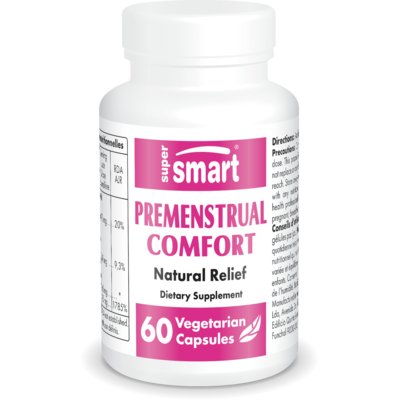
For optimal efficacy, be sure to check the individual bioavailability of a supplement’s ingredients and their content of active principles (the all-in-one formulation PreMenstrual Comfort combines a chasteberry extract standardized to 0.5% vitexin, with vitamin B6, as well as calcium citrate and magnesium bisglycinate, two forms that offer high absorption and excellent digestive tolerance) (16-17).
SuperSmart ADVICE
References
- Webster DE, He Y, Chen SN, Pauli GF, Farnsworth NR, Wang ZJ. Opioidergic mechanisms underlying the actions of Vitex agnus-castus L. Biochem Pharmacol. 2011 Jan 1;81(1):170-7. doi: 10.1016/j.bcp.2010.09.013. Epub 2010 Sep 18. PMID: 20854795; PMCID: PMC2993511.
- Boujbiha MA, Chahdoura H, Adouni K, Ziani BEC, Snoussi M, Chakroun Y, Ciudad-Mulero M, Fernández-Ruiz V, Achour L, Selmi B, Morales P, Flamini G, Mosbah H. Wild Vitex agnus-castus L.: Phytochemical Characterization, Acute Toxicity, and Bioactive Properties. Molecules. 2023 Jun 29;28(13):5096. doi: 10.3390/molecules28135096. PMID: 37446759; PMCID: PMC10343858.
- Zamani M, Neghab N, Torabian S. Therapeutic effect of Vitex agnus castus in patients with premenstrual syndrome. Acta Med Iran. 2012;50(2):101-6. PMID: 22359078.
- Puglia LT, Lowry J, Tamagno G. Vitex agnus castus effects on hyperprolactinaemia. Front Endocrinol (Lausanne). 2023 Nov 21;14:1269781. doi: 10.3389/fendo.2023.1269781. PMID: 38075075; PMCID: PMC10702745.
- Soleymanzadeh F, Mahmoodi M, Shahidi S. Effect of Vitex Agnus-Castus Ethanolic Extract on Sex Hormones in Streptozotocin-Induced Diabetic Rats. J Family Reprod Health. 2020 Jun;14(2):102-105. doi: 10.18502/jfrh.v14i2.4352. PMID: 33603801; PMCID: PMC7865197.
- Höller M, Steindl H, Abramov-Sommariva D, Kleemann J, Loleit A, Abels C, Stute P. Use of Vitex agnus-castus in patients with menstrual cycle disorders: a single-center retrospective longitudinal cohort study. Arch Gynecol Obstet. 2024 Feb 23. doi: 10.1007/s00404-023-07363-4. Epub ahead of print. PMID: 38393671.
- Nasri H, Bahmani M, Shahinfard N, Moradi Nafchi A, Saberianpour S, Rafieian Kopaei M. Medicinal Plants for the Treatment of Acne Vulgaris: A Review of Recent Evidences. Jundishapur J Microbiol. 2015 Nov 21;8(11):e25580. doi: 10.5812/jjm.25580. PMID: 26862380; PMCID: PMC4740760.
- Rafieian-Kopaei M, Movahedi M. Systematic Review of Premenstrual, Postmenstrual and Infertility Disorders of Vitex Agnus Castus. Electron Physician. 2017 Jan 25;9(1):3685-3689. doi: 10.19082/3685. PMID: 28243425; PMCID: PMC5308513.
- Naseri R, Farnia V, Yazdchi K, Alikhani M, Basanj B, Salemi S. Comparison of Vitex agnus-castus Extracts with Placebo in Reducing Menopausal Symptoms: A Randomized Double-Blind Study. Korean J Fam Med. 2019 Nov;40(6):362-367. doi: 10.4082/kjfm.18.0067. Epub 2019 May 9. PMID: 31067851; PMCID: PMC6887765.
- Boujbiha MA, Chahdoura H, Adouni K, Ziani BEC, Snoussi M, Chakroun Y, Ciudad-Mulero M, Fernández-Ruiz V, Achour L, Selmi B, Morales P, Flamini G, Mosbah H. Wild Vitex agnus-castus L.: Phytochemical Characterization, Acute Toxicity, and Bioactive Properties. Molecules. 2023 Jun 29;28(13):5096. doi: 10.3390/molecules28135096. PMID: 37446759; PMCID: PMC10343858.
- Puglia LT, Lowry J, Tamagno G. Vitex agnus castus effects on hyperprolactinaemia. Front Endocrinol (Lausanne). 2023 Nov 21;14:1269781. doi: 10.3389/fendo.2023.1269781. PMID: 38075075; PMCID: PMC10702745.
- Südhof TC. Calcium control of neurotransmitter release. Cold Spring Harb Perspect Biol. 2012 Jan 1;4(1):a011353. doi: 10.1101/cshperspect.a011353. PMID: 22068972; PMCID: PMC3249630.
- Abdi F, Ozgoli G, Rahnemaie FS. A systematic review of the role of vitamin D and calcium in premenstrual syndrome. Obstet Gynecol Sci. 2019 Mar;62(2):73-86. doi: 10.5468/ogs.2019.62.2.73. Epub 2019 Feb 25. Erratum in: Obstet Gynecol Sci. 2020 Mar;63(2):213. PMID: 30918875; PMCID: PMC6422848.
- Facchinetti F, Borella P, Sances G, Fioroni L, Nappi RE, Genazzani AR. Oral magnesium successfully relieves premenstrual mood changes. Obstet Gynecol. 1991 Aug;78(2):177-81. PMID: 2067759.
- Wyatt KM, Dimmock PW, Jones PW, Shaughn O'Brien PM. Efficacy of vitamin B-6 in the treatment of premenstrual syndrome: systematic review. 1999 May 22;318(7195):1375-81. doi: 10.1136/bmj.318.7195.1375. PMID: 10334745; PMCID: PMC27878.
- Nicar MJ, Pak CY. Calcium bioavailability from calcium carbonate and calcium citrate. J Clin Endocrinol Metab. 1985 Aug;61(2):391-3. doi: 10.1210/jcem-61-2-391. PMID: 4008614.
- Uberti F, Morsanuto V, Ruga S, Galla R, Farghali M, Notte F, Bozzo C, Magnani C, Nardone A, Molinari C. Study of Magnesium Formulations on Intestinal Cells to Influence Myometrium Cell Relaxation. Nutrients. 2020 Feb 22;12(2):573. doi: 10.3390/nu12020573. PMID: 32098378; PMCID: PMC7071389.
Keywords




4 Days
Found exactly what I was looking for…
Found exactly what I was looking for already made my first batch of yogurts all is working great! Shipping email notices letting me know tracking number, etc. all around a good deal
CROCKER John
4 Days
Good products and fair prices.
Good products and fair prices.
John Devere
10 Days
Excellent products.
Excellent products. Fast delivery and good customer’s service
BUISSON Laurence
14 Days
Very good product and fabulous service.
Very good product and fabulous service.
LUGO Luz
19 Days
Exceed expectations
Exceed expectations
GEORGE Verne
22 Days
Excellent product
Excellent product , exceptionally efficient process and no pushy sales . Transparency of product origin ,ingredients, quality & description evidence based . Information. User friendly website . easy membership , onboarding & off . EXCELLENT Prices no gimmicks Fast delivery & correct . So glad I found this company .
BEAVERS SANCHEZ Tencia
25 Days
Customer service is excellent.
Customer service is excellent.
Jill
26 Days
Product is wonderful
Product is wonderful. Praise The Lord!
DMHoge
28 Days
You guys have very good quality products
You guys have very good quality products
Mariano Castillo
29 Days
Awesome company.
Very fast shipping, great prices and excellent products.
Susan
33 Days
Best price and quantity of product
Best price and quantity of product Slow delivery though in age of Amazon, but understand cost of service.
CAMPBELL Clayton
33 Days
Exceed
Exceed expectations
GEORGE Verne
42 Days
Clean ingredients
Clean ingredients
chris bentley
45 Days
Above and Beyond!
Above and Beyond!
DOMINIC
56 Days
They get the product to me quickly.
They get the product to me quickly.
GORMLEY Rebecca